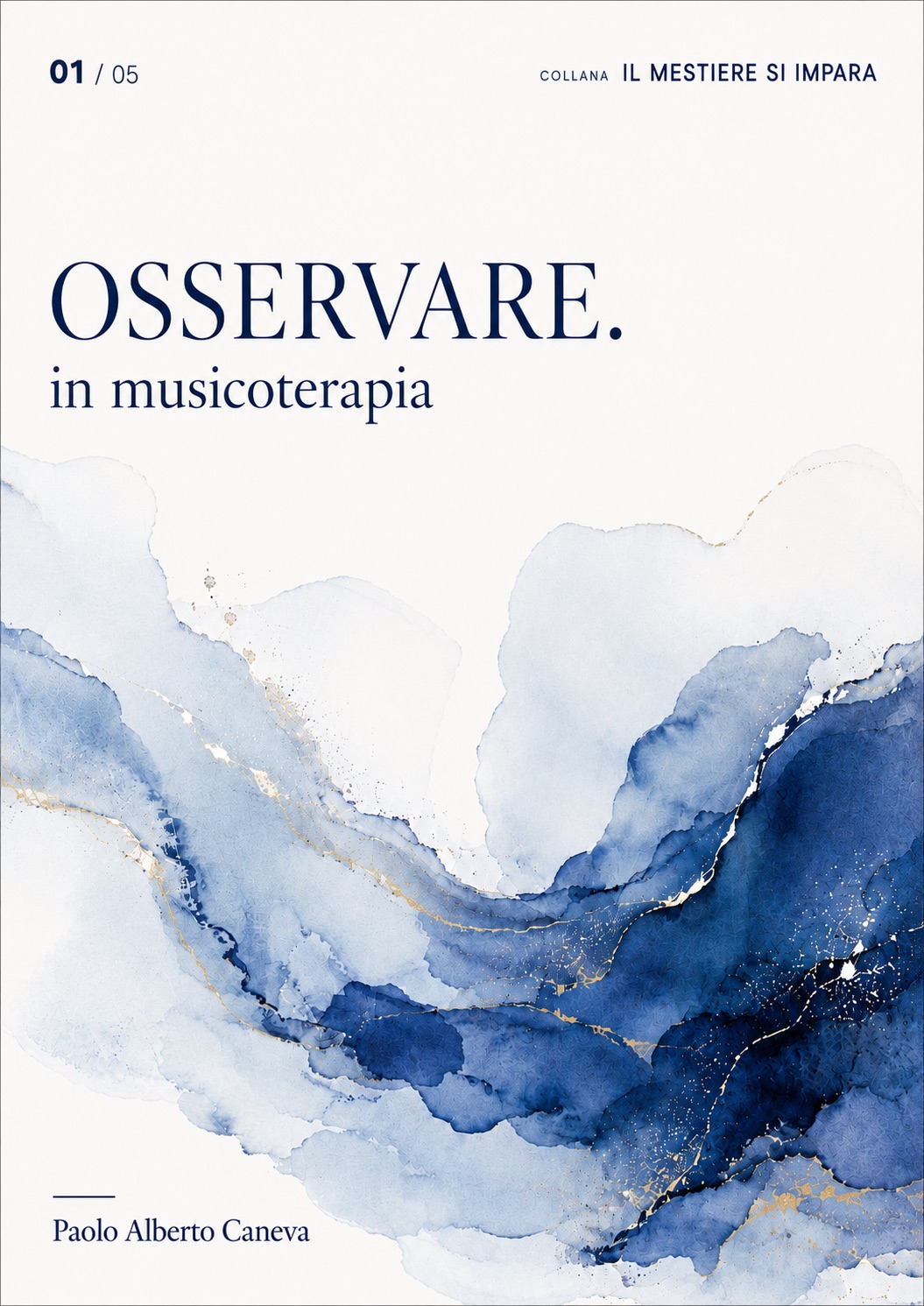
Observing in Music Therapy
Telling what you see from what you think · In Italian
The first skill of the music therapist, the one all others rest on. A volume for learning to recognize the systematic traps of the clinical gaze, to read the person in their body, the music in its parameters, the relationship in its sound exchanges — and to observe the observer, because the measuring instrument for all of this is you.
Download the free PDF →Why this volume exists
Two trainees attend the same session. In the evening, one writes "Maria was happy, she participated a lot"; the other writes what Maria did, when, and compared with which habit. The difference between the two is not talent: it is a discipline that can be learned.
Because in music therapy, observation is not what you do when you are not playing: it is what you do while you play. And you study it the way you study an instrument.
What you find in the PDF (51 pages)
The difference between looking and observing, the systematic traps of the clinical gaze and their defenses, the technical vocabulary of observation
What is observed: the person, the music, the relationship — and yourself
How to build a grid you can fill in five minutes, video up to micro-analysis, how the observed becomes written word
Three ready-to-use model grids, a video-analysis protocol, a set of ten classroom exercises
Who it is for
- → Music therapy students and trainees at their first observations
- → Music therapists who want to make their clinical documentation more solid
- → Teachers and supervisors looking for grids and classroom exercises
- → Anyone starting the series: this is the foundations volume, and the suggested entry point
Download the PDF — it's free
Creative Commons BY-NC-SA 4.0 license. Share it freely, citing the source. The volume is in Italian.
How to cite: Caneva, P. A. (2026). Osservare in musicoterapia. https://canevapaolo.it
Go to Resources and download →Questions? Mentoring is the right place.